

🌿💚 𝑯𝒂𝒑𝒑𝒚 𝑵𝒂𝒕𝒊𝒐𝒏𝒂𝒍 𝑬𝒏𝒗𝒊𝒓𝒐𝒏𝒎𝒆𝒏𝒕𝒂𝒍 𝑨𝒘𝒂𝒓𝒆𝒏𝒆𝒔𝒔 𝑴𝒐𝒏𝒕𝒉! 💚🌿
In celebration of this month, the Department is delighted to share some of our amazing student works! ✨
As we wrap up our series of student research features, we present our final study. 🌏📖
We invite you to read and learn from the insightful work of our student authors!
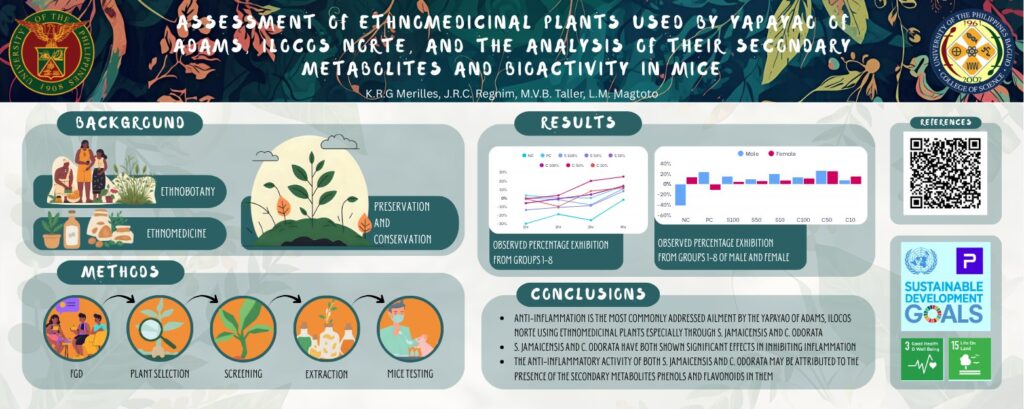
Ethnobotany examines the interactions between primitive societies and the plants they use for cultural purposes, such as healing various ailments. This study focuses on Adams, Ilocos Norte, which hosts a variety of tribes, including the Yapayao. The research was conducted in three phases: focus group discussion, phytochemical analysis, and bioactivity analysis using mice as model organisms. According to the survey, the Yapayao utilize 27 ethnomedicinal plant species, with inflammation being the most commonly treated medical concern. Among these plants, “garem” (𝘚𝘵𝘢𝘤𝘩𝘺𝘵𝘢𝘳𝘱𝘩𝘦𝘵𝘢 𝘫𝘢𝘮𝘢𝘪𝘤𝘦𝘯𝘴𝘪𝘴) and “pantalyon” (𝘊𝘩𝘳𝘰𝘮𝘰𝘭𝘢𝘦𝘯𝘢 𝘰𝘥𝘰𝘳𝘢𝘵𝘢) are particularly notable for their effectiveness against inflammation. Phenols (462.59 ± 19.09, 452.42 ± 35.28 mg GAE/g) and flavonoids (87.32 ± 0.99, 34.91 ± 0.57 mg CE/g) are among the secondary metabolites present in both plants to which the anti-inflammatory activity may be attributed. Lastly, carrageenan-induced paw edema in mice has shown that both 𝘚. 𝘫𝘢𝘮𝘢𝘪𝘤𝘦𝘯𝘴𝘪𝘴 and 𝘊. 𝘰𝘥𝘰𝘳𝘢𝘵𝘢 effectively inhibit inflammation.
The student authors: Maria Victoria Taller (F),Julius Ryan Regnim (M), and Kirsten Ruth Merilles (F), are BS Biology alumni under the concentration 𝗘𝗰𝗼𝗹𝗼𝗴𝘆 & 𝗦𝘆𝘀𝘁𝗲𝗺𝗮𝘁𝗶𝗰𝘀 and conducted this undergraduate thesis study under the supervision of Dr. Liezel M. Magtoto (F).
✍️ Julius Ryan Regnim (M), Maria Victoria Taller (F), and Kirsten Ruth Merilles (F), MT Bagangao (F)
🖼 Julius Ryan Regnim (M), Maria Victoria Taller (F), and Kirsten Ruth Merilles (F)
We support the Sustainable Development Goals
SDG-03 (Good Health and Wellbeing); SDG-15 (Life on Land)