

Happy Teacher’s Day!

As this Teachers’ Day comes to an end, we carry with us the lessons that go beyond cells, systems, and ecosystems. 🧬🌿 Here’s to the mentors who make every discovery more meaningful. 𝐇𝐚𝐩𝐩𝐲 𝐓𝐞𝐚𝐜𝐡𝐞𝐫𝐬’ 𝐃𝐚𝐲! 🔬💛
MS CaRE Thesis Proposal Presentations (Satud, MTB & Pajo, JD)
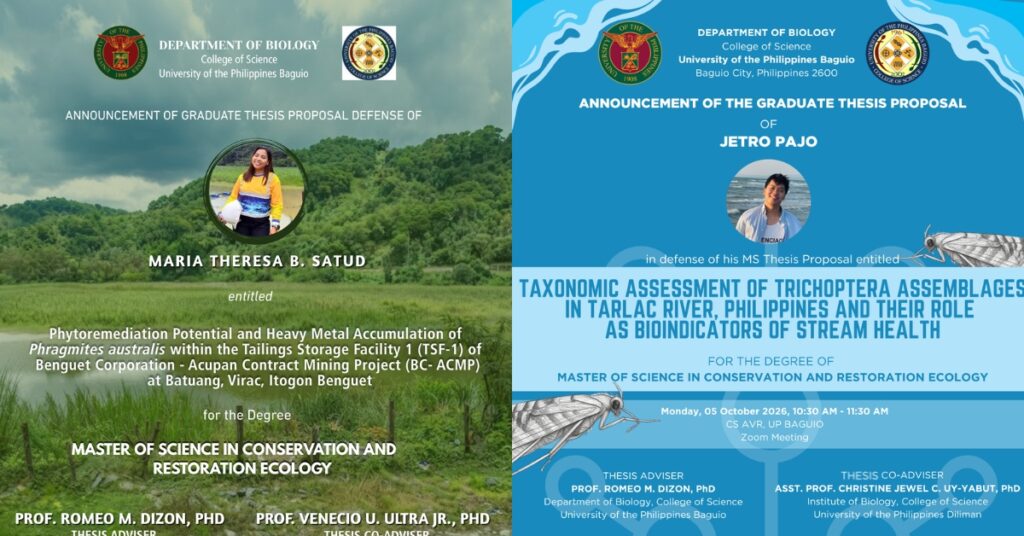
The Department of Biology, College of Science, UP Baguio invites you to the thesis proposal presentation of the following students of Master of Science in Conservation and Restoration Ecology Program: Ms. Maria Theresa B. Satud (9:30 AM – 10:30 AM) “Phytoremediation Potential and Heavy Metal Accumulation of Phragmites australis within the Tailings Storage Facility 1 (TSF-1) of Benguet Corporation – Acupan Contract Mining Project (BC-ACMP) at Batuang, Virac, Itogon, Benguet” Mr. Jetro D. Pajo (10:30 AM – 11:30 AM) “Taxonomic Assessment of Trichoptera Assemblages in Tarlac River, Philippines and their Role as Bioindicators of Stream Health” 📅 Date: 05 October, 2025 (Monday) ⏰ Time: see specific presentations 📍F2F at CS AVR, UP Baguio and Via ZOOM Virtual Conference Join us in this insightful discussion on biodiversity conservation and restoration. See you there! 🌱✨💚
Tracing the Outbreak: A Seminar on Public Health Introduction to Genomic Tools for Cholera Outbreak Response

🧬 TRACING THE OUTBREAKPublic Health Introduction to Genomic Tools for Cholera Outbreak Response Please join us! Learn how genomics and bioinformatics can help support cholera outbreak investigation, surveillance, and public health response. 🎤 Featuring an invited speaker from the Philippine Genome Center (PGC) Mindanao 🤝 In partnership with the DOST-PCHRD Balik Scientist Program in the Cordilleras 📅 8 October 2026⏰ 8:30 AM–12:00 NN 📌 Technical SeminarAn introductory session on genomic tools, sequencing, and bioinformatics for outbreak response. ✨ Don’t miss out! Join us and discover how genomics can help trace disease outbreaks. Register Here: https://bit.ly/tracingtheoutbreak
Call for Student Assistants for 1st Semester (AY 2026-2027)
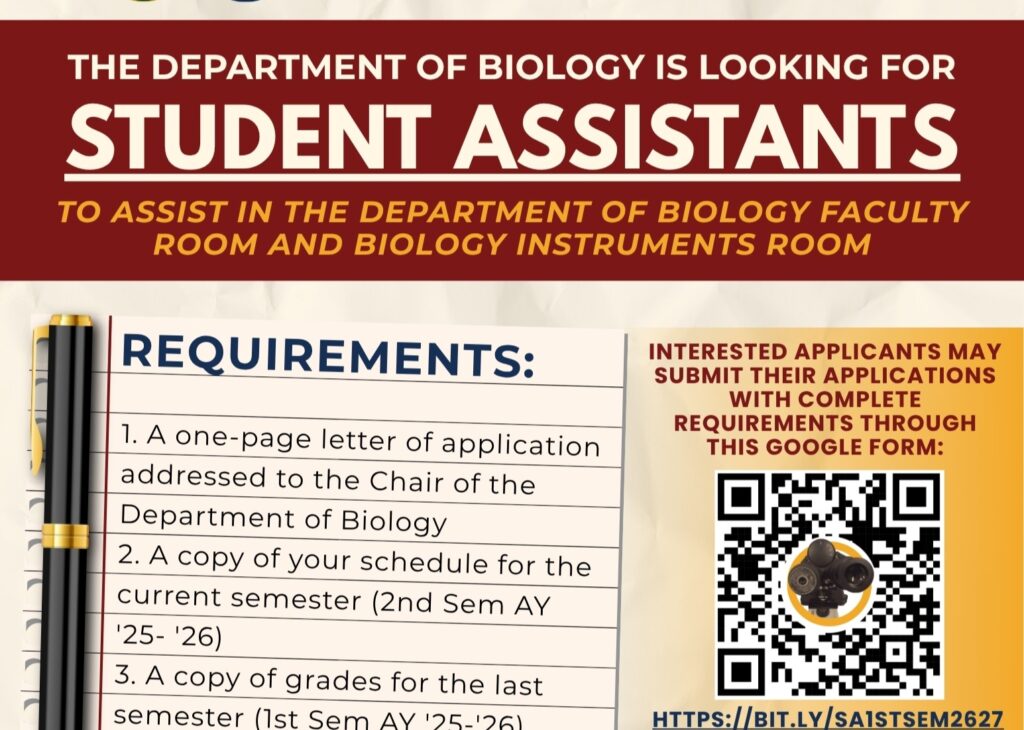
📢ANNOUNCEMENT The Department of Biology is in need of student assistants to assist in the Department of Biology Faculty Room and Biology Instruments Room. Interested applicants may submit their applications with complete requirements through this Google Form:https://forms.gle/XAzkJZP9bEcnWPTw8 The deadline for applications is on September 21, 2026. See poster for more details.
Thesis Students Secure Funding from the 2026 DOST-PCHRD Undergraduate Thesis Grant in Natural Products (First Call)
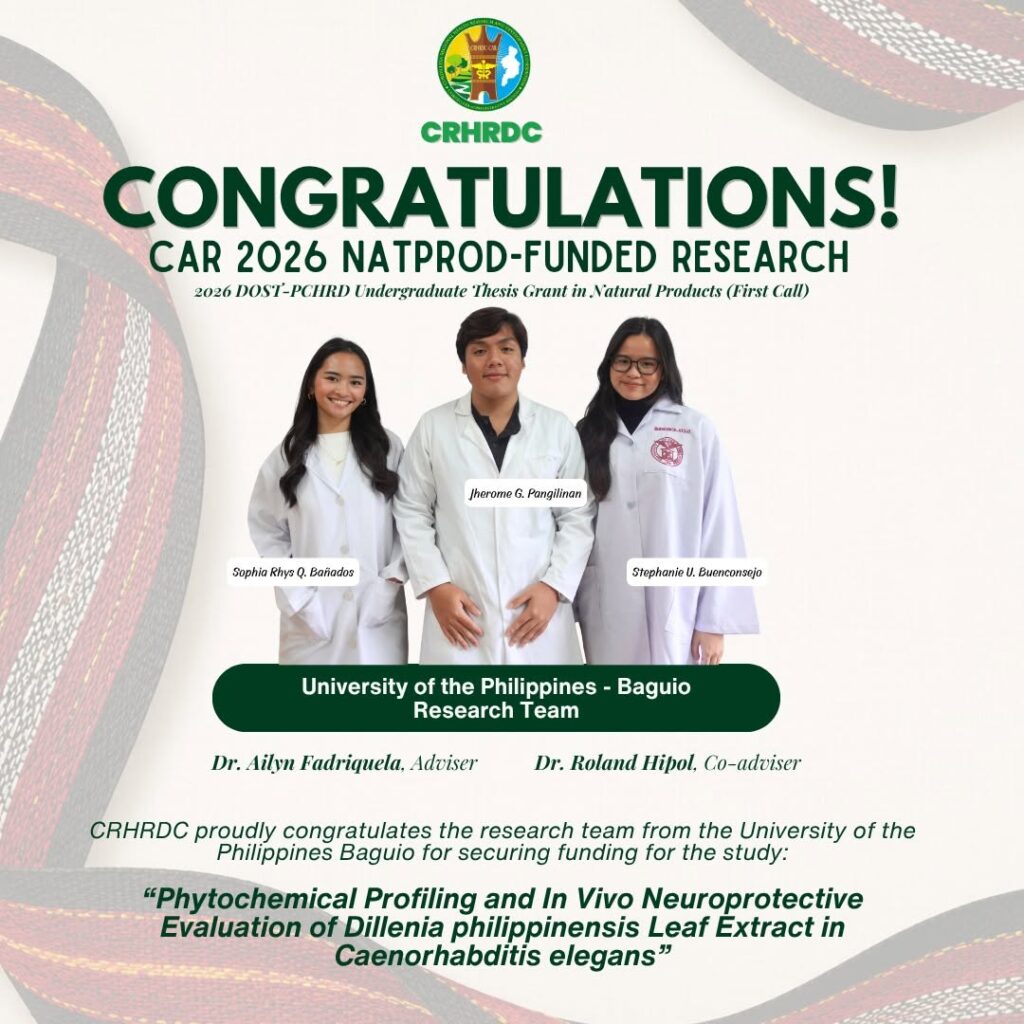
Photo credit from: Cordillera Regional Health Research and Development Consortium – Crhrdc The Department of Biology congratulates our BS Biology students Sophia Rhys Q. Bañados, Stephanie U. Buenconsejo, and Jherome G. Pangilinan for receiving a research grant under the 2026 DOST-PCHRD Undergraduate Thesis Grant in Natural Products (First Call)! The team, under the guidance of Dr. Ailyn Fadriquela and Dr. Roland Hipol, secured the grant for their study, “Phytochemical Profiling and In Vivo Neuroprotective Evaluation of Dillenia philippinensis Leaf Extract in Caenorhabditis elegans.” We extend our warmest congratulations to the team!
Freshie Orientation
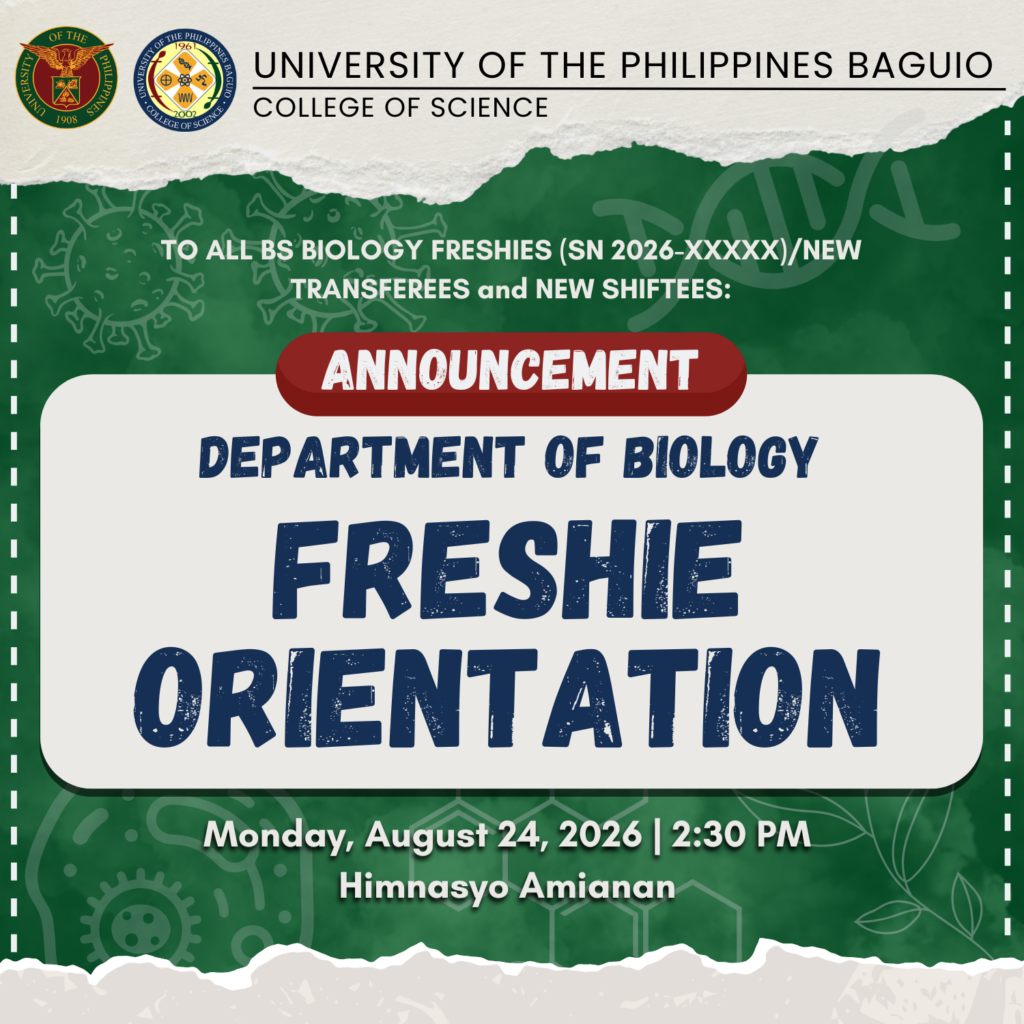
CALLING ALL FRESHIE BIO STUDENTS INCLUDING SHIFTEES AND TRANSFEREES All BS BIO freshie students (SN 2026), including shiftees and transferees, are invited to attend the Department of Biology Freshie Orientation. Get to know the BS Biology Program, meet the Department of Biology faculty and staff, and make new friends as you begin your journey as a Biology student at UPB! WHERE: Himnasyo Amianan (at the HKP Building) WHEN: August 24, 2026, 2:30 PM onwards This event is important, as it provides you with starting guidance as you embark on your BS BIO journey here at UPB. Welcome to the Department of Biology, freshies, shiftees and transferees! We can’t wait to meet you!
Moraceae Tree Diversity, Assemblage, and Density in Disturbed and Less Disturbed Lowland Forests in Mt. Busa-MaKiMa, Sarangani Province, Mindanao Buay, Bhegie May G. The mountains of Mindanao Island, particularly its lowland tropical forest, are known for their high diversity, with species in the family Moraceae contributing to this richness. However, as in other areas of the Philippines, lowland forest in Mindanao are facing increasing pressure from anthropogenic activities. While the extent of tree diversity on the island is relatively well-known, the extent to which this group of trees responds to various levels of disturbance remains unknown. The study sought to understand the possible effects of disturbance on tree species by comparing the species richness, assemblage, abundance, and density under the family of i between a less disturbed and disturbed lowland forest categories in Mt. Busa-Makima LCA. Sampling, using 18 plots, was employed to document the two forest categories. A total of 15 Moracea trees were documented, more species were recorded in the less disturbed area, and there was a notable difference in assemblage. For example, eight species including Artocarpus camansi, Ficus ampelos , Ficus balete, Ficus chryolepsis, Ficus odorata, Ficus pseudopalma, Ficus subulata, and Ficus sp. were the less documented only in disturbed forest category, while Artocarpus heterophyllus and Ficus cf. fistulosa were documented only in the disturbed forest category. Abundance and density also differ in the two forest categories, with the less disturbed forest category having a relatively higher overall number of individuals. Results support the finding that even a moderate level of disturbance can lead to a decline in species diversity. This highlights the critical need for conservation initiatives in Mindanao’s lowland forest to preserve taxonomically significant tree groups.
Comparative Analysis of the Carbon Stock Potential of Native– and Exotic–dominated stands in Camp John Hay Forest Reserve, Baguio City, Philippines Lacadin, Emmanuel B. Camp John Hay Forest Reserve (CJHFR) accounts for more than half of the remaining forest cover of Baguio City. In the face of urbanization, climate change, and biodiversity loss, such urban greenspace (UGS) becomes a critical locus for climate mitigation and biodiversity conservation. Reports indicate that a proliferation of exotic tree species is occurring in the CJHFR. This research quantified and compared the carbon stocks in the tree biomass and soil of native pine- (NPDS), native broadleaf- (NBDS), and exotic-dominated stands (EDS) in the UGS. Allometric computation and standard laboratory analysis of soil carbon indicated that the total carbon density of each stand type was 327,65 MgC/ha, 277.72MgC/ha, 417.24 MgC/ha, respectively. PERMANOVA results showed that this difference in values was not statistically significant (pseudo F= 1.886, p=0.1361). Given that tolerance for exotic-dominated stand in UGS is often premised on their regulating services, and findings indicate the comparable stocking capability of stands regardless of the origin of distribution (i.e., if native or exotic) of the dominant tree, conservation measures to protect the native ecosystem should be prioritized. Moreover, the CO2 eq. of the Forest Reserve was pegged at 346,959.05 MgCO2 e.g. which can potentially neutralize 55.12% of the total carbon footprint of Baguio City. Depending on the pricing mechanism, such could be valued between 1.63 to 27.75 million USD. This highlights the importance and conservation value of keeping UGS intact in a rapidly urbanizing city.
Modeling Conservation Priority and Potential Restoration Areas of Mangroves in Pangasinan, Ilocos Region using Spatially Explicit Models Payopay, John Paul Mangroves provide critical ecosystem services yet face extensive habitat loss and climate impacts that necessitate urgent action This study addressed the lack of integrated multi-criteria approaches for identifying mangrove restoration and conservation priority sites in Pangasinan by developing a spatially explicit framework to guide management decisions. The primary objective was to identify areas that have high restoration potential and conservation priority that are based on habitat suitability. land use/land cover (LULC), and landscape connectivity. This research utilized Sentinel-2 images for LULC classification and mangrove extent mapping. Alongside a suite of bioclimatic, marine, soil, and topographic variables for species distribution modeling (SDM). An ensemble of seven SDM algorithms predicted mangrove habitat suitability across coastal Pangasinan. Receiver Operating Characteristics (ROC) and True Skill Statistics (TSS) were used as model performance metrics. Landscape connectivity was assessed using graph theory. Incorporating local and delta metrics. These analyses were integrated to derive a Restoration Potential Index (RPI) and a Conservation Priority Index (CPI) for the province. The study estimated the current mangrove extent in Pangasinan at 3139.48 ha (accuracy=97.64% : K=0.953). The ensemble SDM identified 40,664 ha of theoretically suitable mangrove habitat, with soil bulk density and topobathymetry being key predictors (ROC=0.995 : TSS +0.921). The RPI analysis drew 10,340 ha as potentially restorable, primarily those in former aquaculture pond within Binmaley, Lingayen, and Dagupan City. The CPI identified 321.76 ha of high-priority conservation areas, concentrated along the Agno River system where high habitat suitability converged with critical landscape connectivity. The identified priority sites are crucial for maintaining regional mangrove biodiversity, enhancing ecosystem connectivity essential for climate adaptation, and sustaining vital ecosystem services. The findings underscore the importance of protecting irreplaceable connector patches and strategically restoring areas that bolster network resilience. This integrated privatization framework provides a scientifically robust basis targeted for mangrove conservation and restoration planning in Pangasinan. The methodology is transferable to other coastal regions offering a valuable tool for informing coastal zone management policies, protected area planning, and aligning local actions with national biodiversity strategies and international conservation commitments.
Interfacing Bat Conservation and Indigenous Cultural Community Perspectives in Aran Cave System, Tuba, Benguet Asinas, Joseph Lemuel G. Bat conservation initiatives must consider both the ecological and social aspects to address the specific needs of local Bat populations and human communities. This study aimed to assess the bat species diversity and indigenous community perspective in a lowland karst area of Tuba, Benguet, Cordillera Administrative Region, in order to develop recommendations for localized bat conservation. Bat sampling was conducted during the wet season of 2023 using a catch-and release method with mist nets, alongside dusk cave emergence count based on video recordings, Community data were collected through preliminary group discussions. Key informant interviews, and household surveys that explored sociodemographic profiles, bat-related interactions, knowledge in beliefs, and conservation attitudes. Survey responses were analyzed using thematic analysis, Chi-square test, and Generalized linear Modelling (GLM). Eight bat species were recorded, including the first documented presence of Macroglossus minimus, Rhinolophus macrotis, and a roost of Rousettus amplexicaudatus in the province of Benguet, at an elevation of about 435-690 masl. The cave bat colony was estimated to exceed a thousand individuals. Moreover, the findings revealed a low extent of human-bat conflict within the community, with minimal habitat overlap, develop wildlife tolerance, and low disease risk perception. Locals demonstrated practical knowledge and positive attitudes towards bats that are not rooted in superstition. By integrating bat diversity data and community perspectives, the study developed strategies for local species conservation and stakeholder engagement. To improve compliance with bat-related laws and regulations, future interventions should prioritize economic opportunities and initiatives to enhance the social acceptability of bats.