

Workshop on Introduction to Invasive Species Risk Assessment
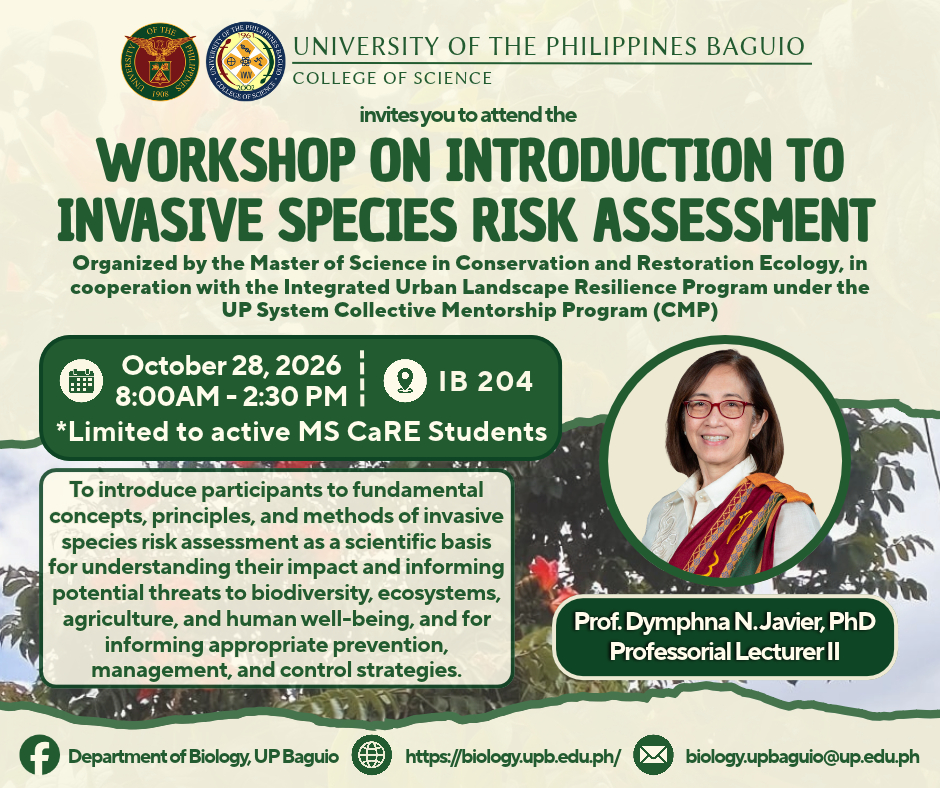
🌿 WORKSHOP ON INTRODUCTION TO INVASIVE SPECIES RISK ASSESSMENT The Master of Science in Conservation and Restoration Ecology (MS CaRE) Program, in collaboration with the Integrated Urban Landscape Resilience Program under the UP System Collective Mentorship Program (CMP), invites you to join the Workshop on Introduction to Invasive Species Risk Assessment, featuring Prof. Dymphna N. Javier, PhD, Professorial Lecturer II, as the resource speaker and facilitator. This workshop aims to introduce participants to the fundamental concepts, principles, and methods of invasive species risk assessment, providing a scientific basis for understanding potential threats to biodiversity, ecosystems, agriculture, and human well-being, and informing appropriate prevention, management, and control strategies. 📅 Date: October 28, 2026 (Wednesday)⏰ Time: 8:00 AM–1:00 PM📍 Venue: IB 204 (In person) *Limited to active MS CaRE Students Let’s strengthen our understanding of invasive species and explore science-based approaches to protecting biodiversity and ecosystem health! 🌱
Department of Biology Faculty Members and MS CaRE Alumni Win Best Scientific Poster Award
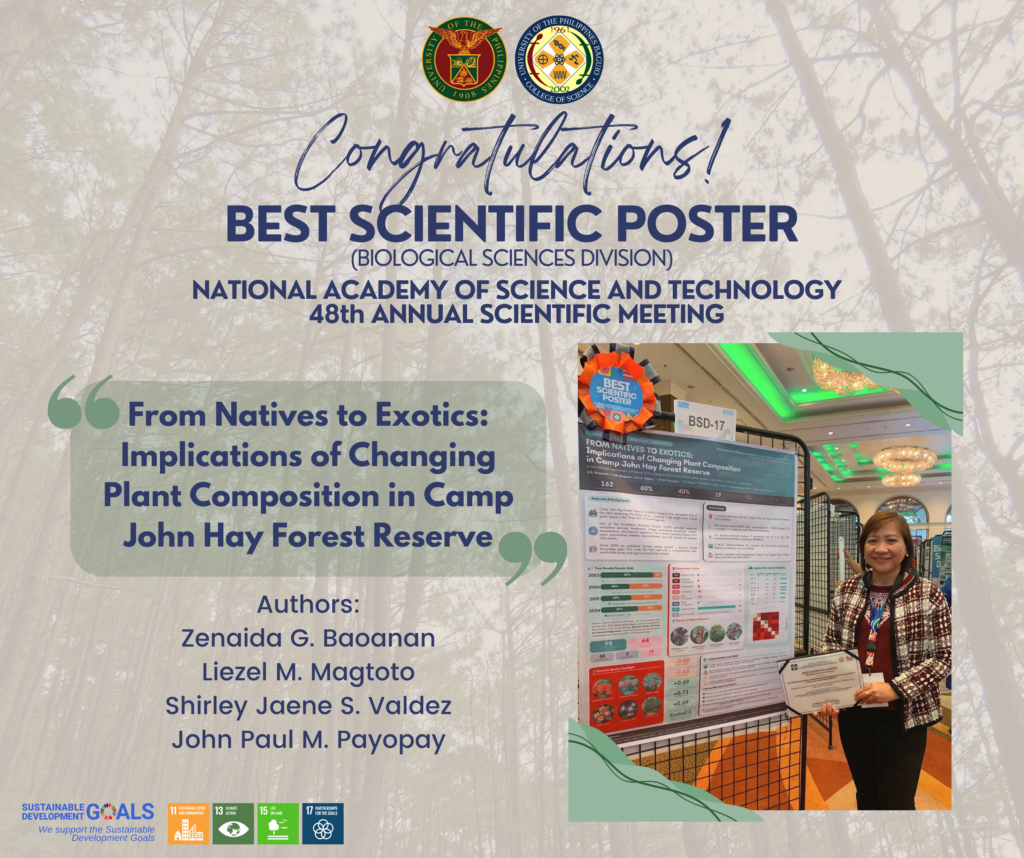
The Department of Biology congratulates our faculty members Prof. Zenaida Baoanan and Assoc. Prof. Liezel Magtoto, and MS Conservation and Restoration Ecology (MS CaRE) alumni Shirley Jaene Valdez and John Paul Payopay, for receiving the Best Scientific Poster Award under the Biological Sciences Division during the 48th Annual Scientific Meeting of the National Academy of Science and Technology. They received this award for their research entitled “From Natives to Exotics: Implications of Changing Plant Composition in Camp John Hay Forest Reserve”. We extend our warmest congratulations to the authors for their contribution to conservation and restoration ecology. #SDGs #SDG11 #SDG13 #SDG15 #SDG17
New publication alert entitled “Status, Emerging Challenges, And Perspectives in Hills and Mountains. The Case of Northern Luzon, Philippines”

The Department of Biology proudly shares a new publication from one of our dedicated faculty members, Dr. Zenaida Baoanan! 📖 This book chapter discusses the fascinating biodiversity and indigenous cultural heritage of Northern Luzon. The abstract can be accessed here: https://www.taylorfrancis.com/chapters/edit/10.1201/9781003688907-6/status-emerging-challenges-perspectives-hills-mountains-zenaida-gutay-baoanan We support the Sustainable Development GoalsSDG-4 (Quality Education); SDG-11 (Sustainable Cities and Communities); SDG-15 (Life on Land)
HIGHLIGHTS: 31st Summer Institute in the Natural Sciences and Mathematics

It’s a wrap! The Department of Biology extends its sincere gratitude to all participants, organizers, and personnel whose efforts contributed to the success of the 31st Summer Institute in the Natural Sciences and Mathematics (SINSM), held on April 16–18, 2026, at the University of the Philippines Baguio. We especially celebrate the 33 participants who joined us in exploring new concepts and techniques in microbial and fungal DNA isolation, PCR amplification, gel electrophoresis, and basic bioinformatics. Your enthusiasm and engagement made this year’s SINSM both insightful and productive. The photos below capture some of the highlights of this enriching experience. We look forward to welcoming you again in next year’s SINSM! We support the Sustainable Development GoalsSDG-3 (Good Health and Well-being); SDG-4 (Quality Education); SDG-5 (Gender Equality); SDG-6 (Clean Water and Sanitation); SDG-9 (Industry, Innovation and Infrastructure); SDG-11 (Sustainable Cities and Communities); SDG-13 (Climate Action); SDG-14 (Life on Water); SDG-15 (Life on Land); SDG-17 (Partnership for Goals)
The Department of Biology, with the College of Science, kicks off the 31st SINSM

The Department of Biology, along with other departments in the College of Science, kicks off the 31st Summer Institute in the Natural Sciences and Mathematics (SINSM). This year, the Department of Biology warmly welcomes our 33 participants from various educational institutions. We support the Sustainable Development GoalsSDG-3 (Good Health and Well-being); SDG-4 (Quality Education); SDG-5 (Gender Equality); SDG-6 (Clean Water and Sanitation); SDG-9 (Industry, Innovation and Infrastructure); SDG-11 (Sustainable Cities and Communities); SDG-13 (Climate Action); SDG-14 (Life on Water); SDG-15 (Life on Land); SDG-17 (Partnership for Goals)
New paper out entitled “Youth networks as bridging actors in environmental governance: Roles, achievements and barriers”

The Department of Biology is proud to share a recent publication by our BS Bio alumnus and former faculty member, Deign Frolley Soriano. The paper is entitled “Youth networks as bridging actors in environmental governance: Roles, achievements and barriers” Congratulations! The full paper may be accessed through the following links:Full Article: https://doi.org/10.1002/pan3.70302Plain Language Summary: https://relationalthinkingblog.com/2026/03/20/plain-language-summary-youth-networks-are-key-but-overlooked-actors-in-environmental-governance/ We support the Sustainable Development GoalsSDG-10 (Reduced Inequalities); SDG-11 (Sustainable Cities and Communities); SDG-13 (Climate Action); SDG-17 (Partnership for Goals)
The Department of Biology adopts a four-day work week arrangement starting March 16, 2026.

To our stakeholders and visitors, please be informed of the adjusted office hours for the Department of Biology.We respectfully request that you take note of these changes and schedule your visits and transactions accordingly. Thank you. We support the Sustainable Development GoalsSDG-11 (Sustainable Cities and Communities); SDG-12 (Responsible Consumption and Production)
RESEARCH HIGHLIGHT: “Taxonomic Diversity and Ecological Assessment of Freycinetia (Sarakat) Species in Eva Garden, Calanasan, Apayao” in celebration of the National Environmental Awareness Month

🌿💚 𝑯𝒂𝒑𝒑𝒚 𝑵𝒂𝒕𝒊𝒐𝒏𝒂𝒍 𝑬𝒏𝒗𝒊𝒓𝒐𝒏𝒎𝒆𝒏𝒕𝒂𝒍 𝑨𝒘𝒂𝒓𝒆𝒏𝒆𝒔𝒔 𝑴𝒐𝒏𝒕𝒉! 💚🌿 In celebration of this month, the Department is delighted to share some of our amazing student works! ✨💫 Take a moment to read, learn, and be inspired by our students’ creativity and passion for the environment. Here’s our second featured entry! 🌏📖 Conservation efforts in forest ecosystems must consider both ecological and taxonomic perspectives to understand the diversity patterns of understudied plant groups such as 𝘍𝘳𝘦𝘺𝘤𝘪𝘯𝘦𝘵𝘪𝘢. As a part of this, a field-based study was carried out to find out the taxonomic diversity and ecological assessment of 𝘍𝘳𝘦𝘺𝘤𝘪𝘯𝘦𝘵𝘪𝘢 species in Eva Garden, Calanasan, Apayao, Philippines. The purpose of the study was to record the species’ richness and abundance and their correlation with environmental factors such as altitude, soil pH, moisture, and light intensity. The research was conducted in two sites: Site A, which was an upland ridge about 1,039 meters above sea level, and Site B, which was a lowland region close to a river at around 727 meters above sea level. A total of eight (😎 Freycinetia species were found, among which five (5) were new records for Apayao. It was also found out that altitude favors the diversity of the species. The results highlight the ecological position of the forests in Apayao for 𝘍𝘳𝘦𝘺𝘤𝘪𝘯𝘦𝘵𝘪𝘢 species and indicate the area’s potential for biodiversity assessments and conservation planning in Northern Luzon. The student authors: Queenie Mae L. Marquez (F), Alyka M. Fangon (F), and Meojanlee B. Agulla (M) are BS Biology alumni under the concentration 𝗘𝗰𝗼𝗹𝗼𝗴𝘆 & 𝗦𝘆𝘀𝘁𝗲𝗺𝗮𝘁𝗶𝗰𝘀 and conducted this undergraduate thesis study under the supervision of Dr. Liezel M. Magtoto (F).✍️ Queenie Mae L. Marquez (F), Alyka M. Fangon (F), and Meojanlee B. Agulla (M) MT Bagangao (F)🖼JQueenie Mae L. Marquez (F), Alyka M. Fangon (F), and Meojanlee B. Agulla (M), JA Alviar (F) We support the Sustainable Development GoalsSDG-11 (Sustainable Cities and Communities); SDG-15 (Life on Land)
RESEARCH HIGHLIGHT: “Interfacing Bat Conservation and Indigenous Cultural Community Perspective in Aran Cave System, Tuba, Benguet” in celebration of the National Environmental Awareness Month

🌿💚 𝑯𝒂𝒑𝒑𝒚 𝑵𝒂𝒕𝒊𝒐𝒏𝒂𝒍 𝑬𝒏𝒗𝒊𝒓𝒐𝒏𝒎𝒆𝒏𝒕𝒂𝒍 𝑨𝒘𝒂𝒓𝒆𝒏𝒆𝒔𝒔 𝑴𝒐𝒏𝒕𝒉! 💚🌿 In celebration of this month — and in honor of the recently concluded 𝘽𝙖𝙩 𝘼𝙥𝙥𝙧𝙚𝙘𝙞𝙖𝙩𝙞𝙤𝙣 𝙈𝙤𝙣𝙩𝙝 and 𝗜𝗻𝗱𝗶𝗴𝗲𝗻𝗼𝘂𝘀 𝗣𝗲𝗼𝗽𝗹𝗲𝘀 𝗠𝗼𝗻𝘁𝗵 last October — the Department is thrilled to share some of our amazing student works! 🦇✨ 💫 Take a moment to read, reflect, and be inspired by our students’ creativity and passion for the environment. Here’s our first featured entry! 🌏📖 Bat conservation initiatives must consider both the ecological and social aspects to address the specific needs of local bat populations and human communities. To contribute to this, graduate student Joseph Lemuel Asinas documented bat species diversity and indigenous community perspectives in Tuba, Benguet, Cordillera Administrative Region. This was primarily aimed at providing scientific information and developing recommendations for localized bat conservation. Their study recorded eight, 8, bat species, including a first record of 𝘔𝘢𝘤𝘳𝘰𝘨𝘭𝘰𝘴𝘴𝘶𝘴 𝘮𝘪𝘯𝘪𝘮𝘶𝘴, 𝘙𝘩𝘪𝘯𝘰𝘭𝘰𝘱𝘩𝘶𝘴 𝘮𝘢𝘤𝘳𝘰𝘵𝘪𝘴, and a roost of 𝘙𝘰𝘶𝘴𝘦𝘵𝘵𝘶𝘴 𝘢𝘮𝘱𝘭𝘦𝘹𝘪𝘤𝘢𝘶𝘥𝘢𝘵𝘶𝘴 for the province of Benguet, at an elevation of about 435–690 masl. The cave bat colony, estimated to exceed a thousand individuals, is the largest documented in the province. This bat population, though large, is determined to cause a low extent of human-bat conflict within the community, with developed wildlife tolerance and low disease risk perception. Furthermore, locals demonstrated practical knowledge and positive attitudes toward bats that are not rooted in superstition. The thriving bat population in Tuba underscores how the integration of practical knowledge and positive attitudes of the indigenous community toward wildlife can foster harmonious and sustainable coexistence between people and nature. Mr Joseph Lemuel Asinas recently graduated from the MS Conservation and Restoration Ecology (MS CaRE) program of the Dept. ✍️ JLA Asinas, YS Picpican, MT Bagangao🖼JLA Asinas, YS Picpican, JA Alviar We support the Sustainable Development GoalsSDG-11 (Sustainable Cities and Communities); SDG-15 (Life on Land)
UPB Faculty receive the 3rd Best Paper Award during the 2025 Agency In-House Review held at Benguet State University (BSU) last August 27-28, 2025

UPB faculty Professor Zenaida G Baoanan, former faculty Asst. Prof. Deign Frolley C. Soriano and current MS CaRE Lecturer Prof. Roscinto Lumbres, along with other co-authors, Prof. Nova D. Doyog and Prof. Lynn J. Talkasen received the 3rd Best Paper Award for the paper entitled “Land Use and Land Cover Assessment Within the Batanes Protected Landscapes and Seascapes” during the 2025 Agency In- House Review held at the Research & Extension Building, BSU, La Trinidad, last August 27-28, 2025. The results of the paper provides a more reliable LULC for monitoring and planning for the six islands covered by the Batanes Protected Landscapes and Seascapes (BPLS). Furthermore, the technique used in the LULC assessment is shared as a reference for future studies. The research article is published and is accessible at the Philippine Journal of Science. It is an output of the research project entitled “Popularizing Access to Biodiversity Information Data and Conservation Opportunities (PABIDACO)” spearheaded by Professor Zenaida G. Baoanan through the funding of the Commission on Higher Education-Discovery-Applied Research and Extension Trans/Inter-disciplinary Opportunities (CHED-DARE TO). This publication supports the Sustainable Development Goals: SDG-11 (Sustainable Cities and Communities), SDG-13 (Climate Action), SDG-14 (Life Below Water), SDG-15 (Life on Land)