

New publication entitled “Baguio’s Biodiversity Greenprint: Conserving and Protecting the City’s Natural Heritage” by the Department of Biology faculty

Congratulations to our esteemed faculty members and researcher from the Department of Biology, College of Science, UP Baguio, for their outstanding contribution to the 𝐧𝐞𝐰𝐥𝐲 𝐫𝐞𝐥𝐞𝐚𝐬𝐞𝐝 𝐩𝐨𝐥𝐢𝐜𝐲 𝐛𝐫𝐢𝐞𝐟 under the 𝐔𝐏𝐂𝐈𝐃𝐒 𝐋𝐨𝐜𝐚𝐥 𝐑𝐞𝐠𝐢𝐨𝐧𝐚𝐥 𝐒𝐭𝐮𝐝𝐢𝐞𝐬 𝐍𝐞𝐭𝐰𝐨𝐫𝐤 – 𝐂𝐨𝐫𝐝𝐢𝐥𝐥𝐞𝐫𝐚 𝐒𝐭𝐮𝐝𝐢𝐞𝐬 𝐂𝐞𝐧𝐭𝐞𝐫, 𝐔𝐏 𝐁𝐚𝐠𝐮𝐢𝐨! ✨ 📄 “𝑩𝒂𝒈𝒖𝒊𝒐’𝒔 𝑩𝒊𝒐𝒅𝒊𝒗𝒆𝒓𝒔𝒊𝒕𝒚 𝑮𝒓𝒆𝒆𝒏𝒑𝒓𝒊𝒏𝒕: 𝑪𝒐𝒏𝒔𝒆𝒓𝒗𝒊𝒏𝒈 𝒂𝒏𝒅 𝑷𝒓𝒐𝒕𝒆𝒄𝒕𝒊𝒏𝒈 𝒕𝒉𝒆 𝑪𝒊𝒕𝒚’𝒔 𝑵𝒂𝒕𝒖𝒓𝒂𝒍 𝑯𝒆𝒓𝒊𝒕𝒂𝒈𝒆” lays down a timely and vital roadmap for biodiversity conservation, climate resilience, and sustainable urban planning in Baguio City. 👏 Kudos to the team:🔬 Asst. Prof. Deign Frolley C. Soriano, MSc🔬 Asst. Prof. Arvin Jet B. Marcaida, PhD🔬 Prof. Romeo M. Dizon, PhD🔬 Asst. Prof. Jeno Rey R. Pagaduan, MSc🔬 Prof. Zenaida G. Baoanan, PhD🔬 Prof. Roland M. Hipol, PhD🔬 Ms. Madonna C. Daquigan, MSc Your work is a significant step toward a greener, more sustainable Baguio and a valuable resource for local and regional environmental policymaking! 🌎🌲 📎 Read the full brief here: https://cids.up.edu.ph/download/baguios-biodiversity-greenprint-conserving-protecting-citys-natural-heritage/?fbclid=IwY2xjawKg8W9leHRuA2FlbQIxMABicmlkETEydTZ6T2J1Uk0xOWlJRVU2AR7EMrYLkYAON1tGfIPsj_JGT5bCaBZ7PyvcM-SriJa7JDhwsFsI8giA0rmVnw_aem_A8xtgPaByu7nrBp3yaLerQ We support the Sustainable Development GoalsSDG-4 (Quality Education); SDG-13 (Climate Action); SDG-15 (Life on Land)
The Department of Biology, College of Science, University of the Philippines Baguio celebrates the International Day of Biodiversity 2025

The Department of Biology, College of Science, University of the Philippines Baguio celebrates the 𝐈𝐧𝐭𝐞𝐫𝐧𝐚𝐭𝐢𝐨𝐧𝐚𝐥 𝐃𝐚𝐲 𝐟𝐨𝐫 𝐁𝐢𝐨𝐝𝐢𝐯𝐞𝐫𝐬𝐢𝐭𝐲 𝟐𝟎𝟐𝟓 with the theme “𝑯𝒂𝒓𝒎𝒐𝒏𝒚 𝒘𝒊𝒕𝒉 𝒏𝒂𝒕𝒖𝒓𝒆 𝒂𝒏𝒅 𝒔𝒖𝒔𝒕𝒂𝒊𝒏𝒂𝒃𝒍𝒆 𝒅𝒆𝒗𝒆𝒍𝒐𝒑𝒎𝒆𝒏𝒕.” We want to showcase the rich biodiversity of the Philippines, particularly ones that are found in areas of Northern Luzon and the Cordillera Region such as the Blue-headed Fantail (𝘙𝘩𝘪𝘱𝘪𝘥𝘶𝘳𝘢 𝘤𝘺𝘢𝘯𝘪𝘤𝘦𝘱𝘴) , Luzon Narrow-mouthed Frog (𝘒𝘢𝘭𝘰𝘶𝘭𝘢 𝘳𝘪𝘨𝘪𝘥𝘢), 𝘓𝘦𝘶𝘤𝘰𝘴𝘺𝘬𝘦 𝘣𝘦𝘯𝘨𝘶𝘦𝘵𝘦𝘯𝘴𝘪𝘴, Northern Luzon giant cloud rat (𝘗𝘩𝘭𝘰𝘦𝘰𝘮𝘺𝘴 𝘱𝘢𝘭𝘭𝘪𝘥𝘶𝘴), 𝘙𝘢𝘧𝘧𝘭𝘦𝘴𝘪𝘢 𝘣𝘢𝘯𝘢𝘰𝘢𝘯𝘢, and 𝘋𝘪𝘱𝘵𝘦𝘳𝘪𝘴 𝘤𝘰𝘯𝘫𝘶𝘨𝘢𝘵𝘢. We call on everyone to conserve and protect our biological and ecological heritage through scientific research, environmental education and advocacy work, and sustainable action. We support the Sustainable Development GoalsSDG-4 (Quality Education); SDG-14 (Life on Water); SDG-15 (Life on Land)
New publication entitled “Bacterial pathogens of non-native rodents and shrews of Busol WAtershed and Forest Reservation, Baguio City” by the Department of Biology faculty
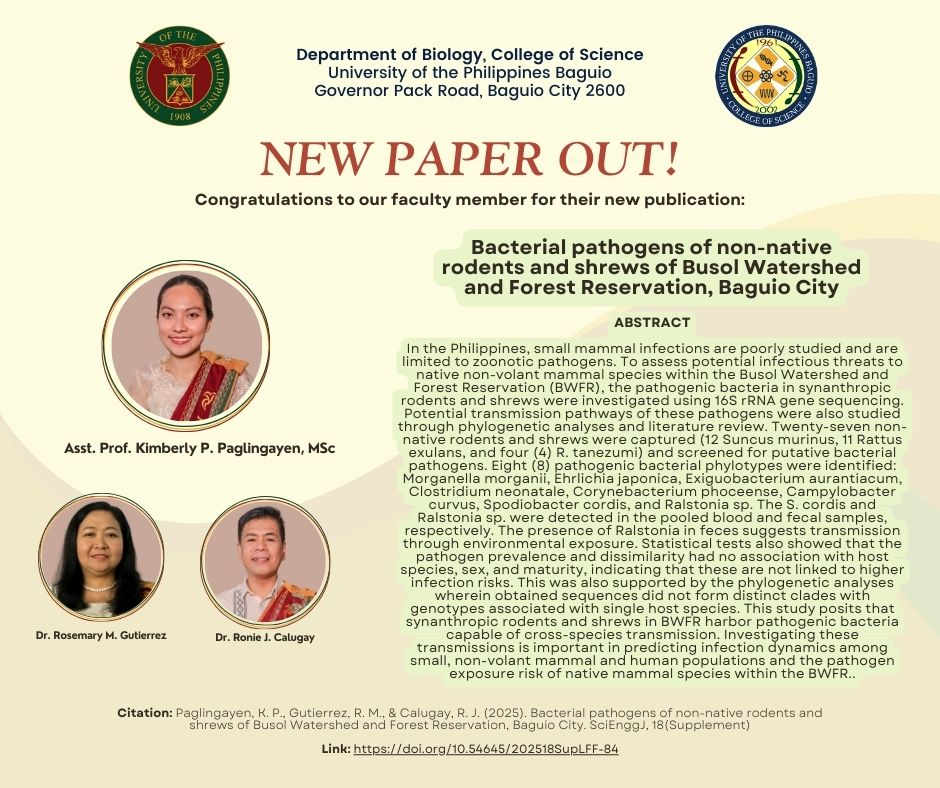
Warmest congratulations to 𝐀𝐬𝐬𝐭 𝐏𝐫𝐨𝐟. 𝐊𝐢𝐦𝐛𝐞𝐫𝐥𝐲 𝐏. 𝐏𝐚𝐠𝐥𝐢𝐧𝐠𝐚𝐲𝐞𝐧, 𝐃𝐫. 𝐑𝐨𝐬𝐞𝐦𝐚𝐫𝐲 𝐌. 𝐆𝐮𝐭𝐢𝐞𝐫𝐫𝐞𝐳, and 𝐃𝐫. 𝐑𝐨𝐧𝐢𝐞 𝐉. 𝐂𝐚𝐥𝐮𝐠𝐚𝐲of the Department of Biology, UP Baguio, for the publication of their study: “𝐁𝐚𝐜𝐭𝐞𝐫𝐢𝐚𝐥 𝐩𝐚𝐭𝐡𝐨𝐠𝐞𝐧𝐬 𝐨𝐟 𝐧𝐨𝐧-𝐧𝐚𝐭𝐢𝐯𝐞 𝐫𝐨𝐝𝐞𝐧𝐭𝐬 𝐚𝐧𝐝 𝐬𝐡𝐫𝐞𝐰𝐬 𝐨𝐟 𝐁𝐮𝐬𝐨𝐥 𝐖𝐚𝐭𝐞𝐫𝐬𝐡𝐞𝐝 𝐚𝐧𝐝 𝐅𝐨𝐫𝐞𝐬𝐭 𝐑𝐞𝐬𝐞𝐫𝐯𝐚𝐭𝐢𝐨𝐧, 𝐁𝐚𝐠𝐮𝐢𝐨 𝐂𝐢𝐭𝐲” 📚SciEnggJ, Vol. 18 (Supplement), 2025 | 🔗https://doi.org/10.54645/202518SupIBG-91 This study explores the bacterial pathogens present in invasive rodents and shrews inhabiting the Busol Watershed—an important forest reserve and water source in Baguio City. By identifying zoonotic risks and potential public health concerns, the research offers valuable information for local disease monitoring and ecosystem health management. It also emphasizes the ecological impacts of non-native species on protected urban environments. 🔬🌍 👏 A vital step toward understanding and mitigating ecological and health threats from biological invasions. We support the Sustainable Development GoalsSDG-4 (Quality Education); SDG-14 (Life Below Water); SDG-15(Life on Land)
New publication entitled “The ecological quality of the Abra River watershed in Northern Luzon, Philippines using the remote sensing ecological index (RSEI) model” by a Department of Biology faculty

Congratulations to 𝐀𝐬𝐬𝐭 𝐏𝐫𝐨𝐟. 𝐃𝐞𝐢𝐠𝐧 𝐅𝐫𝐨𝐥𝐥𝐞𝐲 𝐂. 𝐒𝐨𝐫𝐢𝐚𝐧𝐨 of the Department of Biology, UP Baguio, for the successful publication of his research article: “𝐓𝐡𝐞 𝐞𝐜𝐨𝐥𝐨𝐠𝐢𝐜𝐚𝐥 𝐪𝐮𝐚𝐥𝐢𝐭𝐲 𝐨𝐟 𝐭𝐡𝐞 𝐀𝐛𝐫𝐚 𝐑𝐢𝐯𝐞𝐫 𝐰𝐚𝐭𝐞𝐫𝐬𝐡𝐞𝐝 𝐢𝐧 𝐍𝐨𝐫𝐭𝐡𝐞𝐫𝐧 𝐋𝐮𝐳𝐨𝐧, 𝐏𝐡𝐢𝐥𝐢𝐩𝐩𝐢𝐧𝐞𝐬 𝐮𝐬𝐢𝐧𝐠 𝐭𝐡𝐞 𝐫𝐞𝐦𝐨𝐭𝐞 𝐬𝐞𝐧𝐬𝐢𝐧𝐠 𝐞𝐜𝐨𝐥𝐨𝐠𝐢𝐜𝐚𝐥 𝐢𝐧𝐝𝐞𝐱 (𝐑𝐒𝐄𝐈) 𝐦𝐨𝐝𝐞𝐥” This pioneering study demonstrates the use of the Remote Sensing Ecological Index (RSEI) model and Landsat 8 satellite data in evaluating the environmental quality of the Abra River watershed. It integrates vegetation health, surface temperature, soil conditions, and moisture into a holistic ecological assessment using principal component analysis. The findings provide crucial insights into the condition of the watershed and offer a data-driven basis for large-scale environmental monitoring and sustainable watershed management in Northern Luzon. 🌎✨ 👏A remarkable contribution to environmental science and conservation planning! 📚SciEnggJ, Vol. 18(1), 2025 |🔗https://scienggj.org/2025-191 We support the Sustainable Development GoalsSDG-04 (Quality Education); SDG-15 (Life on Land)
BS Biology students visits Amburayan River Kapangan, Benguet for their Bio 160 course

LOOK: BS Biology students visits Amburayan River Kapangan, Benguet for their Bio 160 course last March 22, 2025. Special thanks to the LGU of Kapangan, particularly the MENRO and Mayor’s Office, and to the Barangay Officials of Taba-ao for their assistance and guidance. Photos taken by faculty chaperones and the BIO 160 students We support the Sustainable Development GoalsSDG-04 (Quality Education); SDG-14 (Life Below Water); SDG-15 (Life on Land)
New publication out entitled “Diversity and community structure of abundant microbial eukaryotic communities across nutrient regimes in the West Philippine Sea” by the Department of Biology faculty

Congratulations to 𝐀𝐬𝐬𝐭. 𝐏𝐫𝐨𝐟. 𝐉𝐞𝐧𝐨 𝐑𝐞𝐲 𝐑. 𝐏𝐚𝐠𝐚𝐝𝐮𝐚𝐧of the Department of Biology, UP Baguio and co-authors for their latest paper, “Diversity and community structure of abundant microbial eukaryotic communities across nutrient regimes in the West Philippine Sea,” now published in Regional Studies in Marine Science! 🥳👏 This study sheds light on how environmental gradients—particularly nutrient levels—shape microbial eukaryotic communities in tropical marine ecosystems, with insights critical for monitoring ecological changes in the West Philippine Sea. 🌐🔬 📖 Read the full article here: https://doi.org/10.1016/j.rsma.2025.104175 We support the Sustainable Development GoalsSDG-04 (Quality Education); SDG-14 (Life Below Water); SDG-15 (Life on Land)
Highlights from the Department of Biology’s participation in the 𝟑𝟎𝐭𝐡 𝐒𝐮𝐦𝐦𝐞𝐫 𝐈𝐧𝐬𝐭𝐢𝐭𝐮𝐭𝐞 𝐢𝐧 𝐍𝐚𝐭𝐮𝐫𝐚𝐥 𝐒𝐜𝐢𝐞𝐧𝐜𝐞𝐬 𝐚𝐧𝐝 𝐌𝐚𝐭𝐡𝐞𝐦𝐚𝐭𝐢𝐜𝐬 (𝐒𝐈𝐍𝐒𝐌) held on April 3–5, 2025 at UP Baguio

In line with the main theme, “𝐑𝐞𝐟𝐢𝐧𝐢𝐧𝐠 𝐇𝐢𝐠𝐡 𝐒𝐜𝐡𝐨𝐨𝐥 𝐄𝐝𝐮𝐜𝐚𝐭𝐢𝐨𝐧 𝐈𝐧𝐬𝐭𝐫𝐮𝐜𝐭𝐢𝐨𝐧 𝐭𝐡𝐫𝐨𝐮𝐠𝐡 𝐌𝐨𝐝𝐞𝐫𝐧 𝐚𝐧𝐝 𝐑𝐞𝐬𝐢𝐥𝐢𝐞𝐧𝐭 𝐓𝐞𝐚𝐜𝐡𝐢𝐧𝐠 𝐚𝐧𝐝 𝐑𝐞𝐬𝐞𝐚𝐫𝐜𝐡 𝐌𝐞𝐭𝐡𝐨𝐝𝐬” the Department of Biology adopted its own focused subtheme: “𝐄𝐧𝐡𝐚𝐧𝐜𝐢𝐧𝐠 𝐋𝐞𝐜𝐭𝐮𝐫𝐞 𝐂𝐨𝐧𝐭𝐞𝐧𝐭 𝐚𝐧𝐝 𝐋𝐚𝐛𝐨𝐫𝐚𝐭𝐨𝐫𝐲 𝐒𝐤𝐢𝐥𝐥𝐬 𝐢𝐧 𝐓𝐞𝐚𝐜𝐡𝐢𝐧𝐠 𝐒𝐞𝐥𝐞𝐜𝐭𝐞𝐝 𝐂𝐨𝐫𝐞 𝐁𝐢𝐨𝐥𝐨𝐠𝐲 𝐓𝐨𝐩𝐢𝐜𝐬.” Participants took part in two specialized tracks: 𝐓𝐫𝐚𝐜𝐤 𝐀: 𝐆𝐞𝐧𝐞𝐫𝐚𝐥 𝐁𝐢𝐨𝐥𝐨𝐠𝐲 𝐓𝐫𝐚𝐜𝐤 𝐁: 𝐌𝐨𝐥𝐞𝐜𝐮𝐥𝐚𝐫 𝐁𝐢𝐨𝐥𝐨𝐠𝐲 Through a mix of lectures and hands-on workshops, educators explored innovative approaches to teaching biology and strengthening lab instruction across various educational levels. We support the Sustainable Development GoalsSDG-03 (Good Health and Well-Being); SDG-04 (Quality Education); SDG-08 (Decent Work and Economic Growth); SDG-15 (Life on Land); SDG-17 (Partnership for Goals)
Department of Biology faculty represented the University of the Philippines Baguio in the recent update of terrestrial and integrated Key Biodiversity Areas (KBAs) in the Philippines

Assoc. Prof. Aris Reginaldo, Assoc. Prof. Liezel Magtoto, and Asst. Prof. Arvin Jet Marcaida of the Department of Biology, UP Baguio, represented the university in the recent update of terrestrial and integrated Key Biodiversity Areas (KBAs) in the Philippines, reinforcing their commitment to biodiversity conservation. The updating of terrestrial and integrated KBAs of the Philippines is being led by the Biodiversity Conservation Society of the Philippines, Haribon Foundation, UP Institute of Biology’s Biodiversity Research Laboratory, and the Institute of Biology Alumni of UP Diliman, through the generous support of Forest Foundation Philippines, Foundation for the Philippine Environment, and Wildlife Conservation Society Philippines. photos (c) Biodiversity Conservation Society of the Philippines We support the Sustainable Development GoalsSDG-13 (Climate Action); SDG-14 (Life Below Water); SDG-15 (Life on Land); SDG-17 (Partnership for Goals)
New paper out entitled “Water quality of Balili River before, during and after COVID: lessons learned and ways forwards for tropical river remediation”

Congratulations to Prof. Romeo M. Dizon, and MS CaRE graduate Fernie D. SitSit for their latest publication on the water quality of Balili River before, during, and after COVID-19! Their study, spanning from 2018 to 2023, examines how the pandemic influenced river water quality and what happened afterward. Findings reveal that while water quality improved during lockdowns, pollution levels increased again post-COVID, though not as severely as pre-pandemic levels. The research highlights the role of natural purification processes in tropical rivers and suggests ways forward for sustainable river remediation and water management. This study contributes to ongoing efforts to achieve SDG 6: Clean Water and Sanitation and provides valuable insights for conservation initiatives. Read more here: https://doi.org/10.1007/s10452-024-10151-0 We support the Sustainable Development GoalsSDG-04 (Quality Education); SDG-13 (Climate Action); SDG-14 (Life Below Water); SDG-15 (Life on Land)
New paper out entitled “Biodiversity and conservation assessment of the non-marine mollusks of the Batanes Group of Islands, Philippines”

Congratulations to Prof. Zenaida G. Baoanan, PhD, and her co-authors on their new publication, “Biodiversity and conservation assessment of the non-marine mollusks of the Batanes Group of Islands, Philippines,” in the Philippine Journal of Systematic Biology! This study explores the unique non-marine mollusks of the Batanes Islands, identifying 41 species and highlighting the need to protect these fragile ecosystems. The research shows the importance of conservation efforts to safeguard the rich biodiversity of these islands. Read the full paper here: http://asbp.org.ph/…/PJSBv18-04_Batomalaque-et-al-2025.pdf We support the Sustainable Development GoalsSDG-04 (Quality Education); SDG-13 (Climate Action); SDG-14 (Life Below Water); SDG-15 (Life on Land)