

RESEARCH HIGHLIGHT: “Taxonomic Diversity and Ecological Assessment of Freycinetia (Sarakat) Species in Eva Garden, Calanasan, Apayao” in celebration of the National Environmental Awareness Month
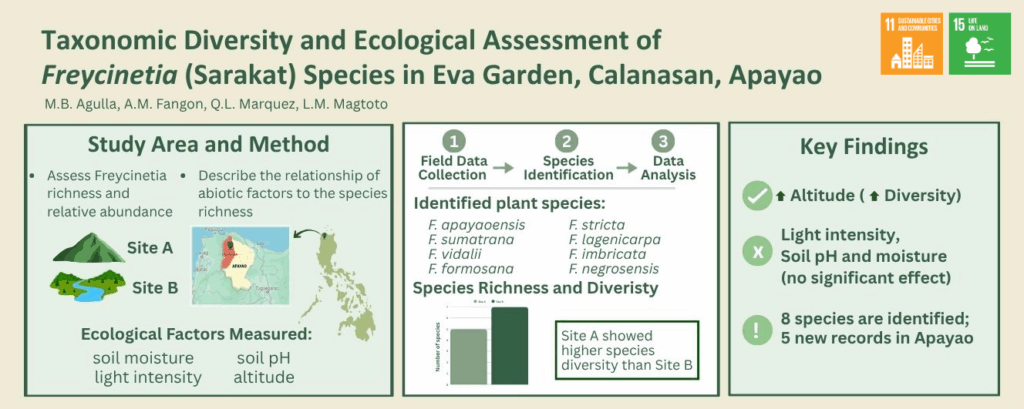
🌿💚 𝑯𝒂𝒑𝒑𝒚 𝑵𝒂𝒕𝒊𝒐𝒏𝒂𝒍 𝑬𝒏𝒗𝒊𝒓𝒐𝒏𝒎𝒆𝒏𝒕𝒂𝒍 𝑨𝒘𝒂𝒓𝒆𝒏𝒆𝒔𝒔 𝑴𝒐𝒏𝒕𝒉! 💚🌿 In celebration of this month, the Department is delighted to share some of our amazing student works! ✨💫 Take a moment to read, learn, and be inspired by our students’ creativity and passion for the environment. Here’s our second featured entry! 🌏📖 Conservation efforts in forest ecosystems must consider both ecological and taxonomic perspectives to understand the diversity patterns of understudied plant groups such as 𝘍𝘳𝘦𝘺𝘤𝘪𝘯𝘦𝘵𝘪𝘢. As a part of this, a field-based study was carried out to find out the taxonomic diversity and ecological assessment of 𝘍𝘳𝘦𝘺𝘤𝘪𝘯𝘦𝘵𝘪𝘢 species in Eva Garden, Calanasan, Apayao, Philippines. The purpose of the study was to record the species’ richness and abundance and their correlation with environmental factors such as altitude, soil pH, moisture, and light intensity. The research was conducted in two sites: Site A, which was an upland ridge about 1,039 meters above sea level, and Site B, which was a lowland region close to a river at around 727 meters above sea level. A total of eight (😎 Freycinetia species were found, among which five (5) were new records for Apayao. It was also found out that altitude favors the diversity of the species. The results highlight the ecological position of the forests in Apayao for 𝘍𝘳𝘦𝘺𝘤𝘪𝘯𝘦𝘵𝘪𝘢 species and indicate the area’s potential for biodiversity assessments and conservation planning in Northern Luzon. The student authors: Queenie Mae L. Marquez (F), Alyka M. Fangon (F), and Meojanlee B. Agulla (M) are BS Biology alumni under the concentration 𝗘𝗰𝗼𝗹𝗼𝗴𝘆 & 𝗦𝘆𝘀𝘁𝗲𝗺𝗮𝘁𝗶𝗰𝘀 and conducted this undergraduate thesis study under the supervision of Dr. Liezel M. Magtoto (F).✍️ Queenie Mae L. Marquez (F), Alyka M. Fangon (F), and Meojanlee B. Agulla (M) MT Bagangao (F)🖼JQueenie Mae L. Marquez (F), Alyka M. Fangon (F), and Meojanlee B. Agulla (M), JA Alviar (F) We support the Sustainable Development GoalsSDG-11 (Sustainable Cities and Communities); SDG-15 (Life on Land)
The 5-day World Lecture Series during November 13-17 organized by the Department of Biology, College of Science, UP Baguio, concludes

The 5-day World Expert Lecture Series (WELS) with Dr. Raelene Crandall and Dr. Jennifer Fill, organized by the Department of Biology, with the Lecture Series Committee, College of Science, UP Baguio has come to a close. The World Expert Lecture Series was celebrated along with the National Science Technology Week, ran from November 13 to 17. Explored topics included the initiatives to safeguard the Camp John Hay Forest Reserve, which were shared by distinguished speakers, Engr. Editha M Mejia and Professor Zenaida Baoanan. WELS speakers Dr. Crandall and Dr Fill also shared the ecology of pine savannas and Florida’s experience with the use of fire to harness and promote diversity in forest and savanna ecosystems, emphasizing the role of fire and fire regimes as important ecological processes. A two-day field trip and workshop at Camp John Hay was conducted on November 15–16 with MS CaRE and undergraduate students. The activity focused on analyzing tree size structure to understand the effects of fire on population dynamics. The event concluded with a discussion of possible collaboration with the faculty of the Department of Biology, Dr. Crandall, Dr. Fill, and other members of government agencies. A huge and heartfelt thank you to Dr. Crandall and Dr. Fill for generously sharing their vast knowledge, expertise, and insights with us. We appreciate the time and effort dedicated to preparing the presentations and the courage to present a new perception about fire in a community where fires carry a negative connotation. We hope that you have enjoyed your short stay in the Philippines. We would also like to extend our appreciation to all participants who have joined us throughout this lecture series. This event wouldn’t be successful without your active involvement and enthusiasm throughout the event. We would also like to extend our thanks to Assoc. Prof. Aris Reginaldo and the UP Office of International Linkages for making this event possible. Your hard work and commitment to fostering international collaboration have played a crucial role in bringing this lecture series to life. We wish to also recognize the CLAN Office, CPDMO, and the OPA for providing us with much-needed technical support. See you at our next WELS! We support the Sustainable Development GoalsSDG-4 (Quality Education); SDG-15 (Life on Land); SDG-17 (Partnership for the Goals)
The World Expert Lecture Series (WELS) with Dr. Raelene Crandall and Dr. Fill officially commences
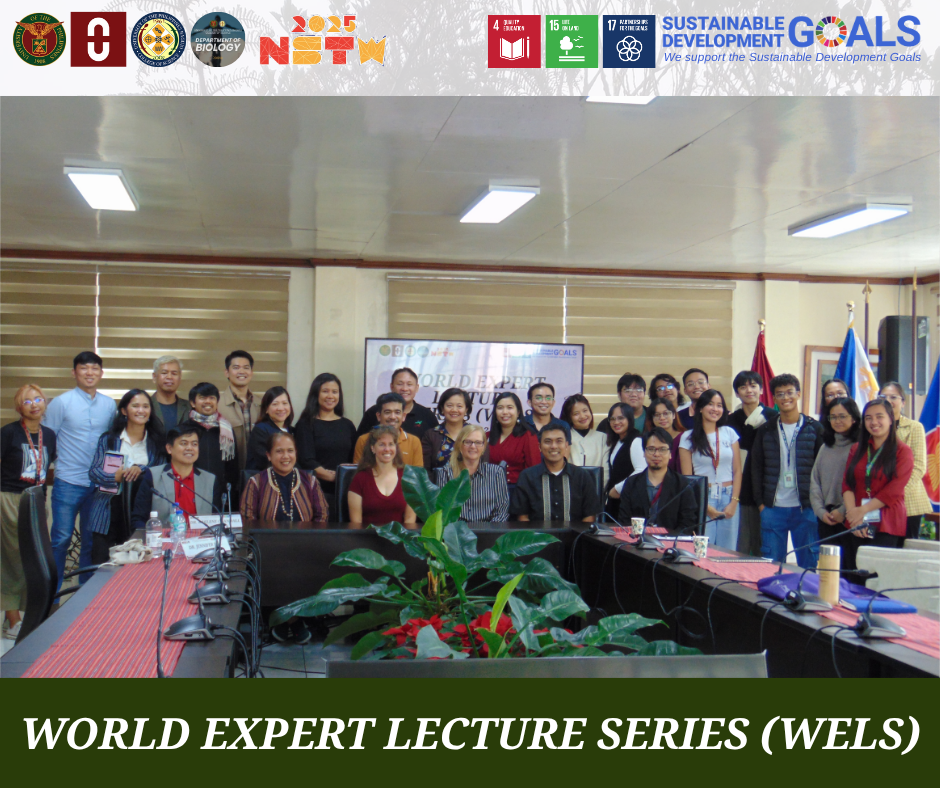
Today, the Department of Biology and the Lecture Series Committee of the College of Science officially opened the 2nd 2025 World Expert Lecture Series (WELS) in celebration with the National Science Technology Week (NSTW)! We were honored to have Vice Chancellor Leah Abayao deliver the opening remarks who inspired the participants to maximize the activity for program improvement by extending the laboratory to the communities. Prof. Aris Reginaldo followed by sharing the significance and the upcoming activities of WELS. Dean Gilbert Peralta capped the event with closing remarks that fanned the flames of curiosity, scientific inquiry, and more meaningful collaboration. A warm welcome to Dr. Fill and Dr. Crandall—we look forward to engaging and insightful discussions in the coming days! This event would not have been possible without the collective efforts of the Lecture Series Committee (College of Science), Office of International Linkages (OIL-OVPAA), Campus Planning and Development Office, and the Computer/LAN Office. We support the Sustainable Development GoalsSDG-4 (Quality Education); SDG-15 (Life on Land); SDG-17 (Partnership for the Goals)
RESEARCH HIGHLIGHT: “Interfacing Bat Conservation and Indigenous Cultural Community Perspective in Aran Cave System, Tuba, Benguet” in celebration of the National Environmental Awareness Month
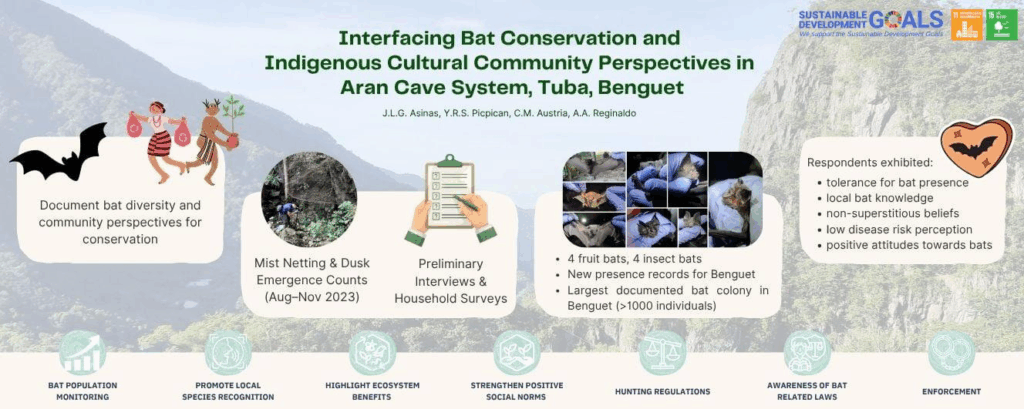
🌿💚 𝑯𝒂𝒑𝒑𝒚 𝑵𝒂𝒕𝒊𝒐𝒏𝒂𝒍 𝑬𝒏𝒗𝒊𝒓𝒐𝒏𝒎𝒆𝒏𝒕𝒂𝒍 𝑨𝒘𝒂𝒓𝒆𝒏𝒆𝒔𝒔 𝑴𝒐𝒏𝒕𝒉! 💚🌿 In celebration of this month — and in honor of the recently concluded 𝘽𝙖𝙩 𝘼𝙥𝙥𝙧𝙚𝙘𝙞𝙖𝙩𝙞𝙤𝙣 𝙈𝙤𝙣𝙩𝙝 and 𝗜𝗻𝗱𝗶𝗴𝗲𝗻𝗼𝘂𝘀 𝗣𝗲𝗼𝗽𝗹𝗲𝘀 𝗠𝗼𝗻𝘁𝗵 last October — the Department is thrilled to share some of our amazing student works! 🦇✨ 💫 Take a moment to read, reflect, and be inspired by our students’ creativity and passion for the environment. Here’s our first featured entry! 🌏📖 Bat conservation initiatives must consider both the ecological and social aspects to address the specific needs of local bat populations and human communities. To contribute to this, graduate student Joseph Lemuel Asinas documented bat species diversity and indigenous community perspectives in Tuba, Benguet, Cordillera Administrative Region. This was primarily aimed at providing scientific information and developing recommendations for localized bat conservation. Their study recorded eight, 8, bat species, including a first record of 𝘔𝘢𝘤𝘳𝘰𝘨𝘭𝘰𝘴𝘴𝘶𝘴 𝘮𝘪𝘯𝘪𝘮𝘶𝘴, 𝘙𝘩𝘪𝘯𝘰𝘭𝘰𝘱𝘩𝘶𝘴 𝘮𝘢𝘤𝘳𝘰𝘵𝘪𝘴, and a roost of 𝘙𝘰𝘶𝘴𝘦𝘵𝘵𝘶𝘴 𝘢𝘮𝘱𝘭𝘦𝘹𝘪𝘤𝘢𝘶𝘥𝘢𝘵𝘶𝘴 for the province of Benguet, at an elevation of about 435–690 masl. The cave bat colony, estimated to exceed a thousand individuals, is the largest documented in the province. This bat population, though large, is determined to cause a low extent of human-bat conflict within the community, with developed wildlife tolerance and low disease risk perception. Furthermore, locals demonstrated practical knowledge and positive attitudes toward bats that are not rooted in superstition. The thriving bat population in Tuba underscores how the integration of practical knowledge and positive attitudes of the indigenous community toward wildlife can foster harmonious and sustainable coexistence between people and nature. Mr Joseph Lemuel Asinas recently graduated from the MS Conservation and Restoration Ecology (MS CaRE) program of the Dept. ✍️ JLA Asinas, YS Picpican, MT Bagangao🖼JLA Asinas, YS Picpican, JA Alviar We support the Sustainable Development GoalsSDG-11 (Sustainable Cities and Communities); SDG-15 (Life on Land)
FACULTY HIRING FOR SECOND SEMESTER AY 25-26
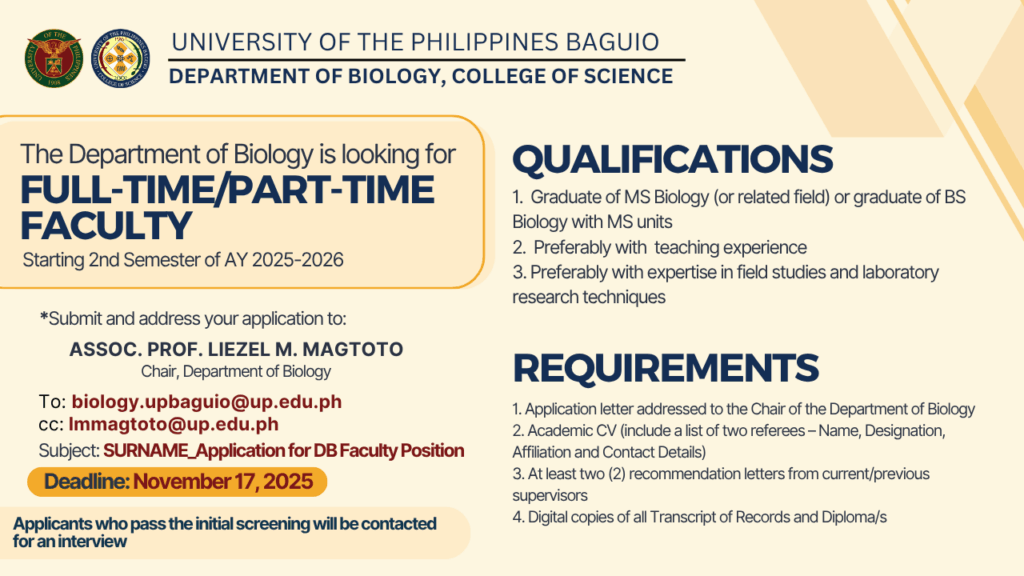
JOB OPENING! 📣👩🏫👨🏫The Department of Biology is looking for 𝐟𝐮𝐥𝐥-𝐭𝐢𝐦𝐞 𝐨𝐫 𝐩𝐚𝐫𝐭-𝐭𝐢𝐦𝐞 𝐭𝐞𝐚𝐜𝐡𝐢𝐧𝐠 𝐬𝐭𝐚𝐟𝐟 for the 2nd Semester, A.Y. 2025–2026 (tentative start: January 2026). The Department of Biology upholds equal opportunity employment. We encourage applications from qualified individuals regardless of gender, disability, age, civil status, religion, or ethnicity. Interested applicants may refer to the attached details and submit all requirements by 𝐍𝐨𝐯𝐞𝐦𝐛𝐞𝐫 𝟏𝟕, 𝟐𝟎𝟐𝟓
ZUMBAYANIHAN 2.0
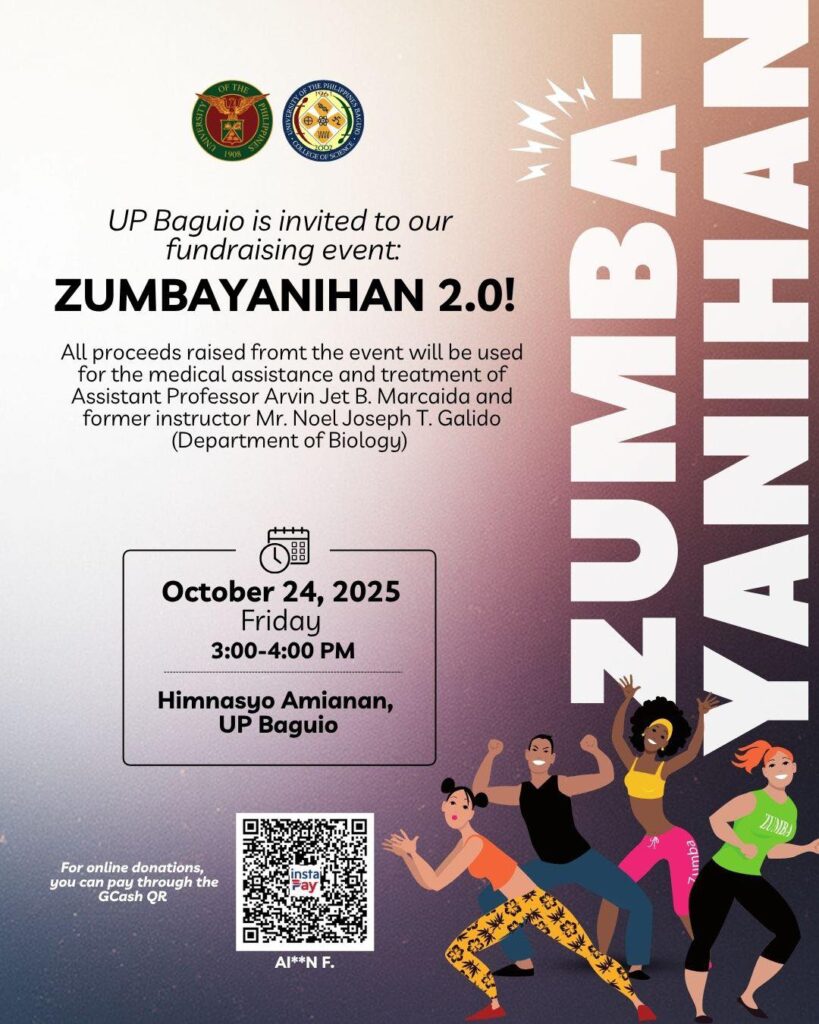
We thank you UPB community for joining us this Zumbayanihan 2.0! We are able to collect funds, thanks to your support. Iyaman!
BS Biology Graduates pass the 2025 Physician Licensure Exam
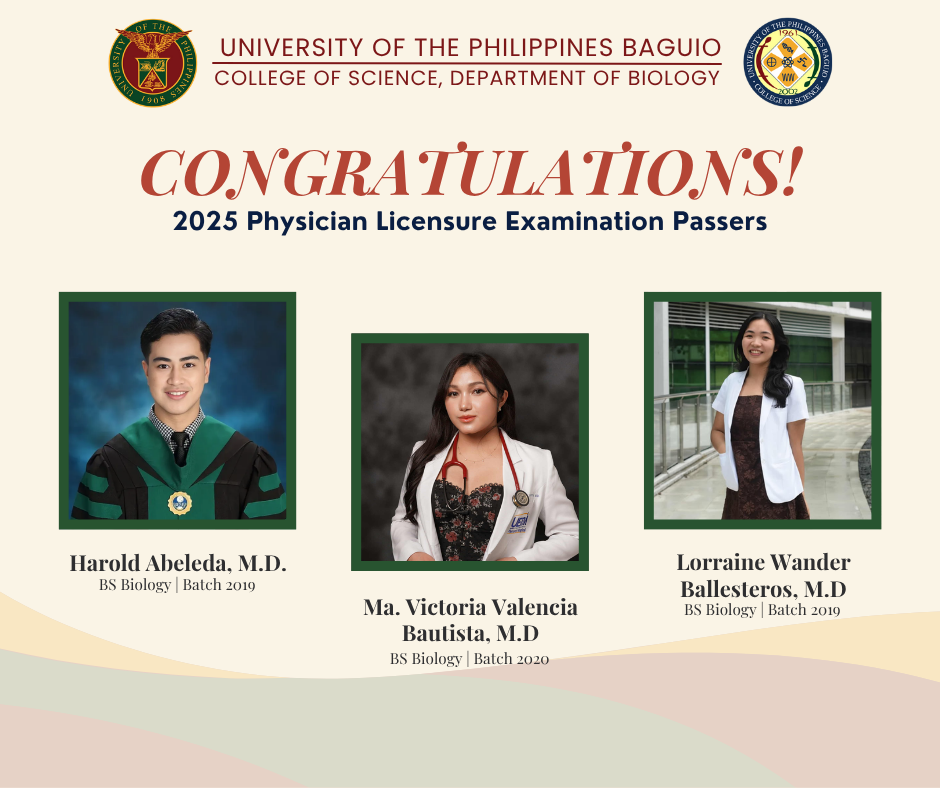
The Department of Biology congratulates our hardworking alumni who have earned their medical licenses in the recent Physician Licensure Examination released last October 16, 2025. The Department takes great pride in your remarkable achievement. With your newly earned license, may you continue to serve our people and our nation as dedicated doctors upholding honor, excellence, and compassion. We support the Sustainable Development GoalsSDG-04 (Quality Education); SDG-08 (Decent Work and Economic Growth)
MS CaRE conducts Knowledge-Sharing
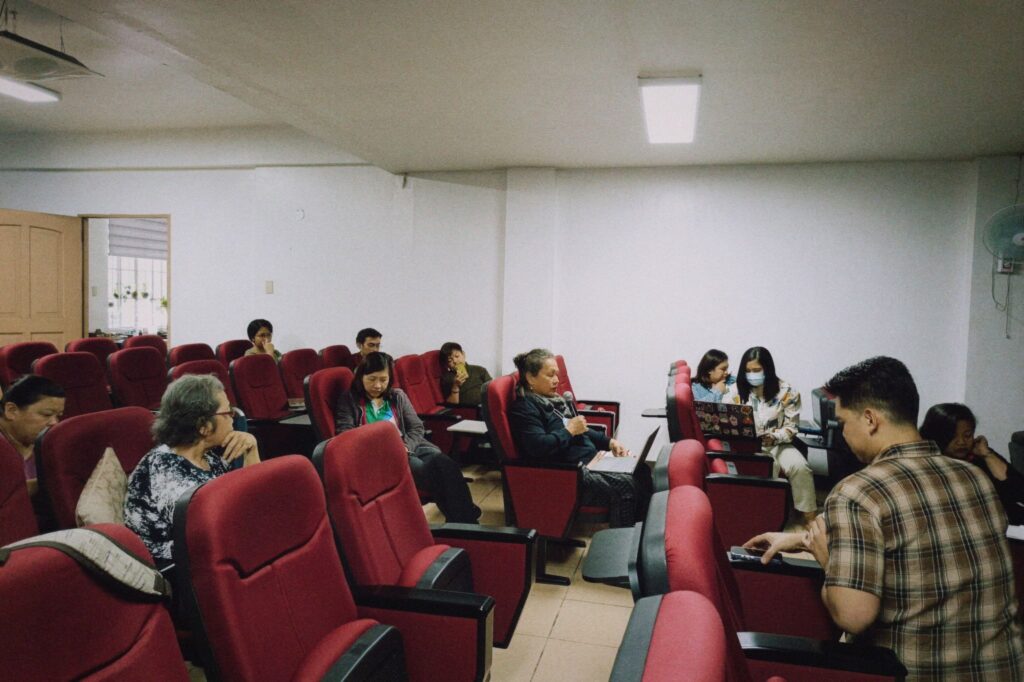
The MS CaRE Program conducts a knowledge-sharing workshop to promote the delivery of courses through sound and innovative pedagogy. In particular, mentors for the course CRE 283: Ethical, Legal, and Social Issues on the Environment have been invited to share best practices in teaching, enabling and empowering younger graduate faculty members to handle the course with confidence and integrity. We support the Sustainable Development GoalsSDG-4 (Quality Education)
DB Faculty Participates in RDI Assessment Training
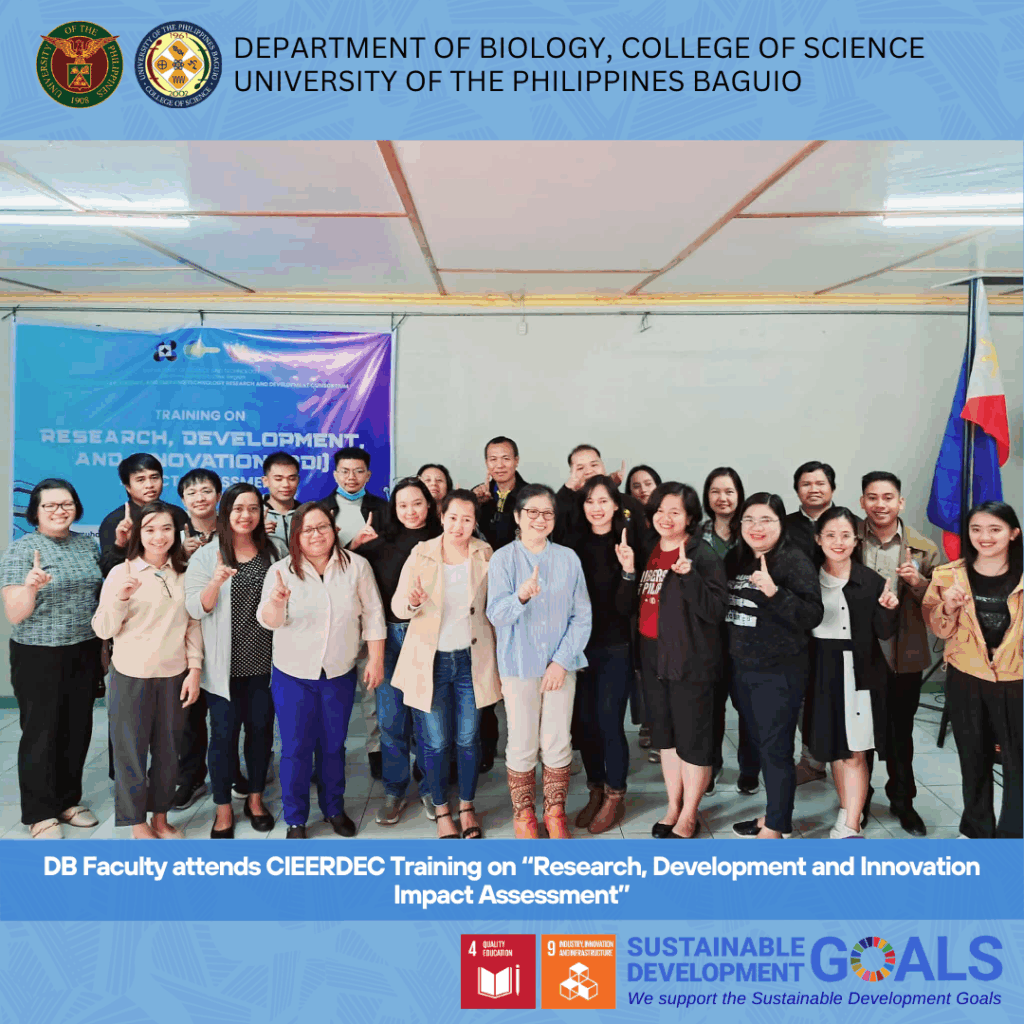
Asst. Prof. Racquel C. Barcelo of the Department of Biology attends Training on Research, Development, and Innovation (RDI) Impact Assessment currently ongoing at the Damuhan Hall, ATI-CAR, BSU Compound, Km. 5, La Trinidad, Benguet. The training, organized by the Cordillera Industry, Energy, and Emerging Technology Research and Development Consortium (CIEERDEC), aims to establish the importance of impact assessments in RDI, and to equip its participants with the skills to prepare their own impact assessments. The training workshop will run for three days from September 23-25, 2025, comprised of a series of knowledge-sharing sessions and hands-on training on impact assessment. Through participation in similar workshops, the Department aims to produce researches that have sustainable impacts, consequently serving our community and beneficiaries more effectively. We support the Sustainable Development GoalsSDG-4 (Quality Education); SDG-9 (Industry, Innovation, and Infrastructure)
Congratulations to a BS Biology Student for becoming a SHEStems Scholarship Awardee
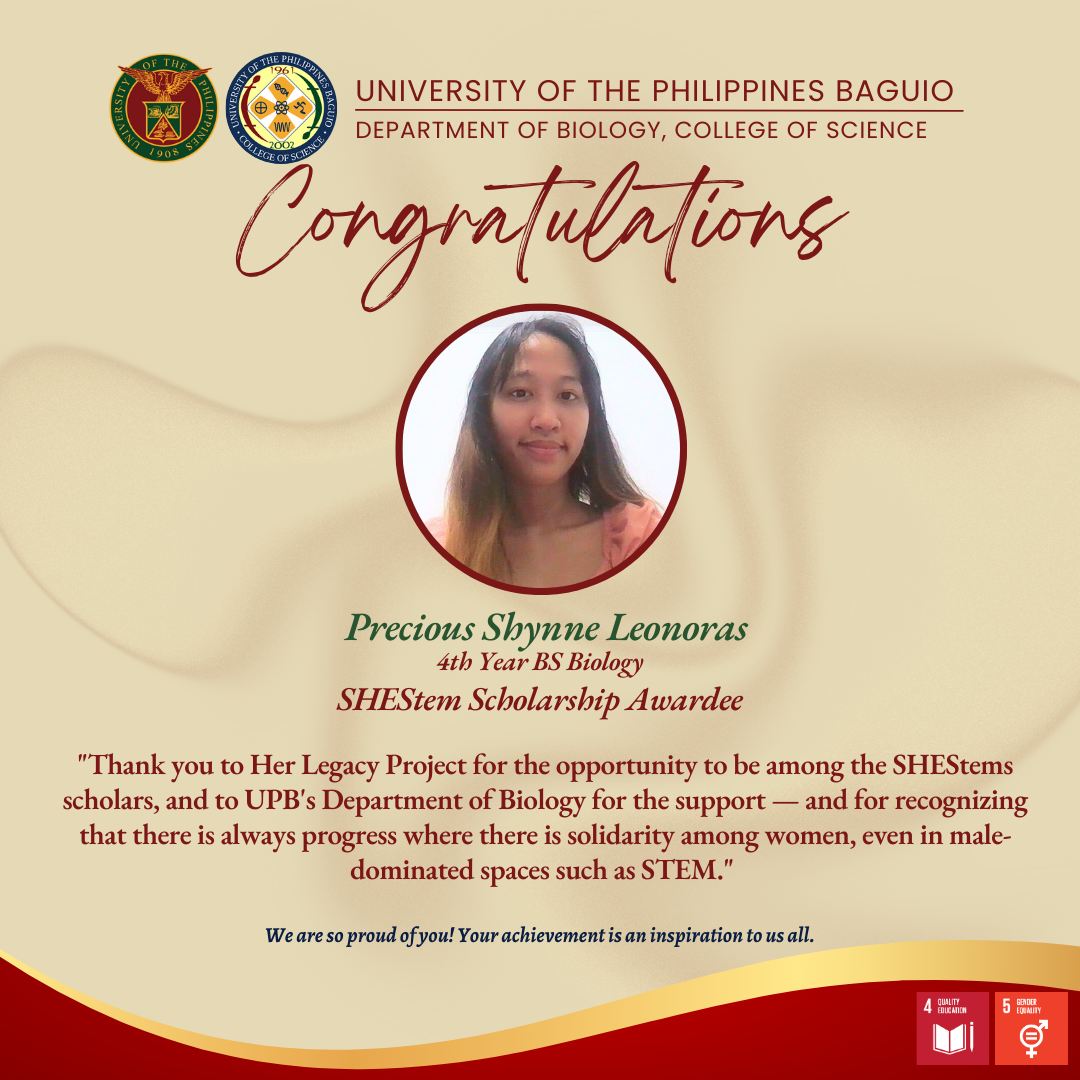
The Department of Biology congratulates another SHESTEMS Scholarship Awardee, Precious Shynne D. Leonoras. Precious is a senior BS Biology student with an AoC in Microbiology. Scholar Leonoras also wishes to express her heartfelt gratitude to the Her Legacy Project where she shares, “Thank you to Her Legacy Project for the opportunity to be among the SHEStems scholars, and to UPB’s Department of Biology for the support — and for recognizing that there is always progress where there is solidarity among women, even in male-dominated spaces such as STEM.” Congratulations, Precious Shynne D. Leonoras! We support the Sustainable Development GoalsSDG-4 (Quality Education); SDG-5 (Gender Equality)