

The Department of Biology is pleased to congratulate our faculty member for publishing two papers along with our alumni! 🔬
Microbes shape both emerging technologies and the environments around us. We have two recent publications that look at bacteria in very different settings: one is on a thermophilic bacterium from a hot spring in Bokod, Benguet to explore a greener way of producing silver nanoparticles, while the other follows how bacterial communities begin to colonize plastic surfaces in the coastal waters of southern Singapore.
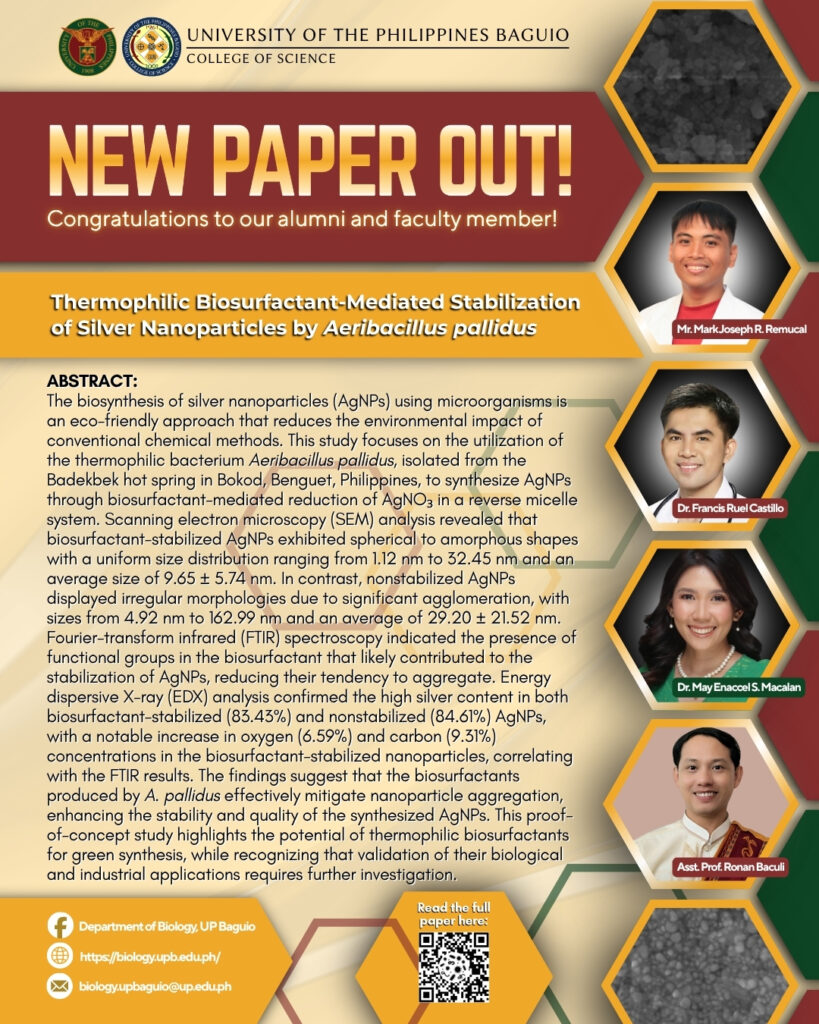
The first study used the thermophilic bacterium Aeribacillus pallidus, isolated from the Badekbek hot spring in Bokod, Benguet, to synthesize silver nanoparticles (AgNPs) through biosurfactant-mediated reduction of AgNO₃. Biosurfactant-stabilized AgNPs were spherical to amorphous, averaging 9.65 ± 5.74 nm, while nonstabilized AgNPs were irregular and agglomerated, averaging 29.20 ± 21.52 nm. FTIR indicated biosurfactant functional groups likely contributed to stabilization, and EDX confirmed high silver content in both samples (83.43% stabilized, 84.61% nonstabilized). The biosurfactants reduced nanoparticle aggregation, though applications require further investigation.
Access the full paper here: https://doi.org/10.22146/jtbb.20876
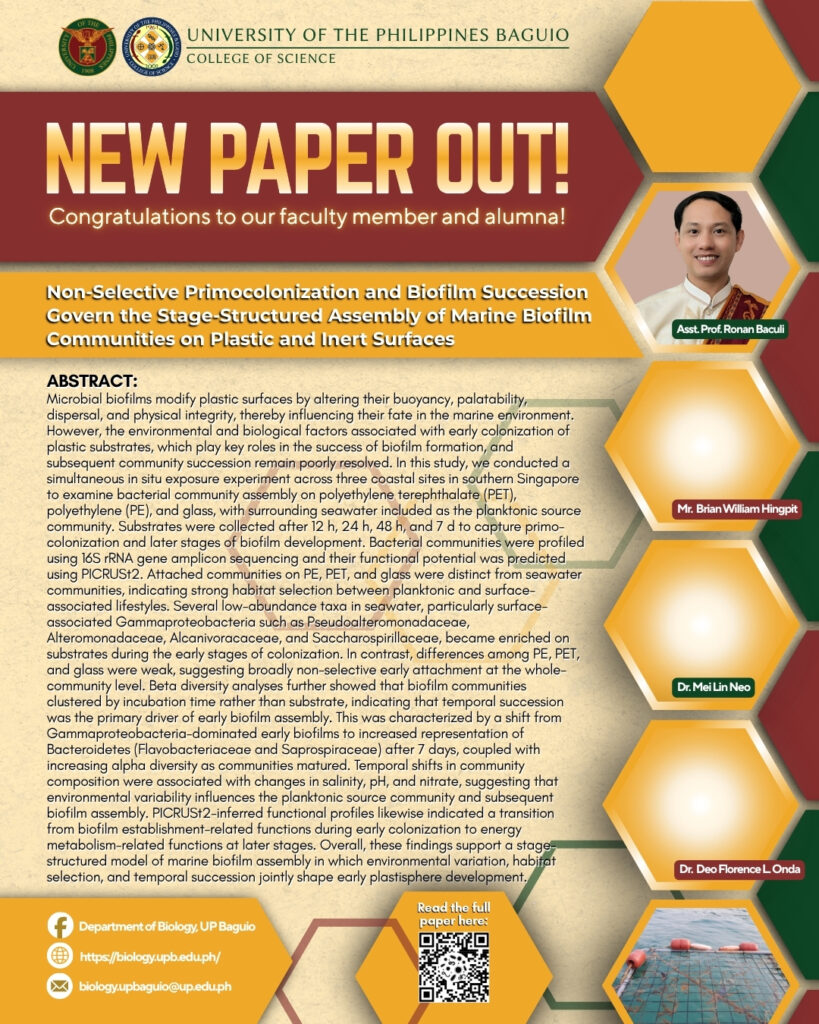
The second study examined bacterial colonization of PET, PE, and glass at three coastal sites in southern Singapore over 12 h to 7 days, using 16S rRNA sequencing and PICRUSt2. Attached communities differed from seawater communities, with low-abundance Gammaproteobacteria enriched early on all surfaces. Differences among substrates were weak, and communities clustered by incubation time instead. After 7 days, Bacteroidetes (Flavobacteriaceae and Saprospiraceae) increased along with alpha diversity, and predicted functions shifted from biofilm establishment to energy metabolism. Community changes were associated with salinity, pH, and nitrate, supporting a stage-structured model of early plastisphere development.
Access the full paper here: https://doi.org/10.22146/jtbb.20876
The Department of Biology extends its warmest congratulations to our faculty and alumni for these significant contributions! 🌿
𝗪𝗲 𝘀𝘂𝗽𝗽𝗼𝗿𝘁 𝘁𝗵𝗲 𝗦𝘂𝘀𝘁𝗮𝗶𝗻𝗮𝗯𝗹𝗲 𝗗𝗲𝘃𝗲𝗹𝗼𝗽𝗺𝗲𝗻𝘁 𝗚𝗼𝗮𝗹𝘀
#SDG4 #SDG14